
Part Of the BePeace Newborn Reflexes 101 series
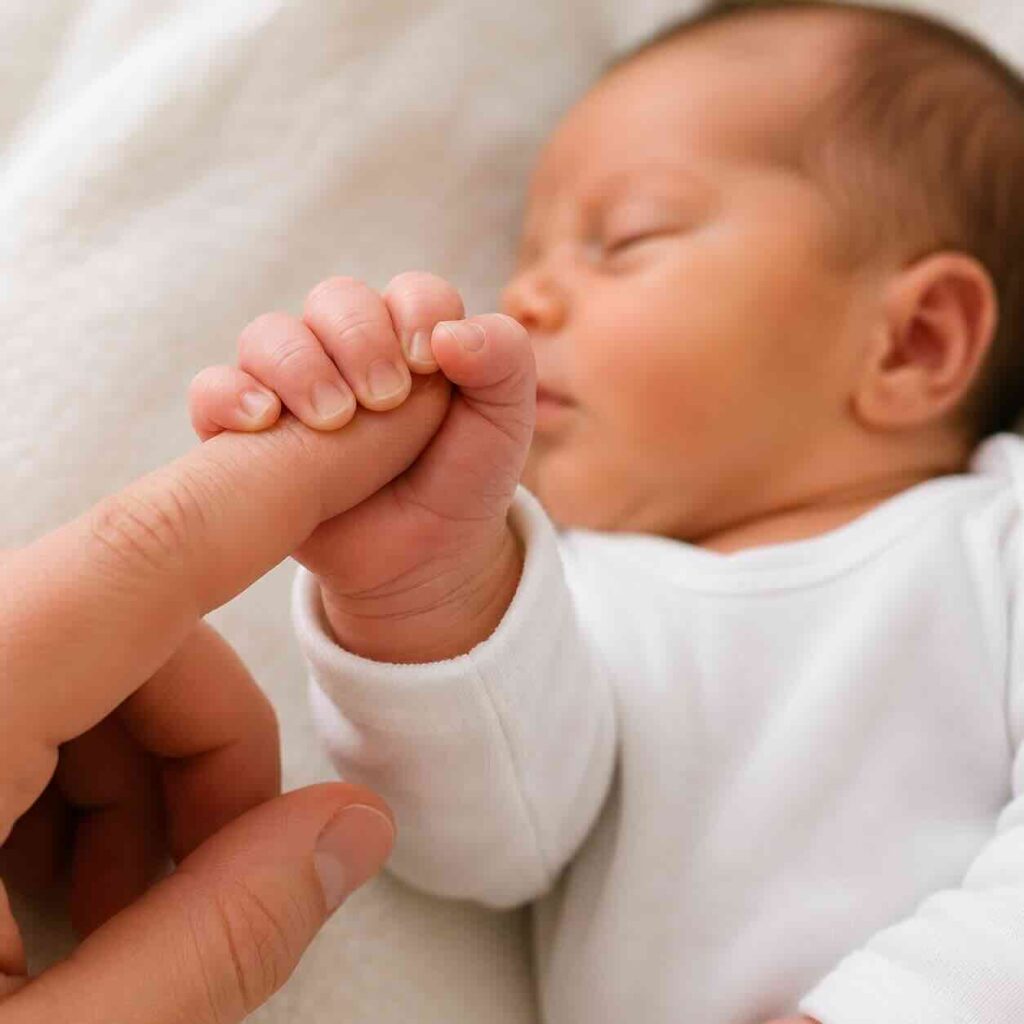
The Palmar Grasp Reflex in babies is a natural response seen in newborns and young infants. When you gently place your finger or an object in a baby’s palm, they will instinctively grasp it tightly. This reflex typically appears around 1 month of age and gradually disappears by the time the baby is 5 to 6 months old. The presence of this reflex is a sign of normal neurological development, reflecting the maturation of the nervous system. Parents often observe their baby holding onto objects or fingers with surprising strength, which can be quite endearing.
Why does this happen?
The palmar grasp reflex is an involuntary movement observed in newborns and young infants. When the palm of a baby’s hand is touched or stimulated, the fingers automatically curl and grip. This reflex involves several body systems working together, primarily the sensory and motor systems of the nervous system.
Here’s how it works: When an object or finger touches the baby’s palm, sensory neurons in the skin send signals to the brain through the spinal cord. The brain then processes this information and triggers a motor response. In this case, the brain sends signals back through the spinal cord to the muscles of the hand, causing them to contract and form a grasp.
This reflex is part of the baby’s developing nervous system and typically appears around the 16th week of pregnancy. It usually persists until the baby is about 5 to 6 months old, at which point it begins to diminish as the baby’s voluntary control over their movements increases.
The palmar grasp reflex helps with the baby’s early interactions and development. For example, it can be seen when the baby’s hand closes around a finger or a small object. This reflex is a natural part of a baby’s developmental process and helps in the maturation of motor skills and neural pathways.
Development over time
The palmar grasp reflex typically diminishes around 5 to 6 months of age as the nervous system matures. Initially, when you stroke a newborn’s palm, their fingers curl inward automatically. As the baby grows, this reflex starts to fade. By about 5 months, the reflex becomes less prominent, and the baby begins to develop more intentional grasping actions. By 9 months, the reflex is usually gone, replaced by more controlled hand movements. This change reflects the development of more sophisticated motor skills and the maturation of neural pathways responsible for voluntary movements.
Normal variation
The palmar grasp reflex can vary among newborns and young children in terms of how strongly it is shown, how often it occurs, and how long it lasts. This variation is considered normal during development. Some babies may grip tightly when their palm is stroked, while others might have a less firm grasp. The frequency of this reflex can also differ; some babies might exhibit the reflex every time their palm is touched, whereas others might show it less often. Additionally, the duration for which the reflex is present can vary, with some infants displaying it for a longer period compared to others. These differences are all part of the natural range of normal development.
Why understanding this matters
Understanding the palmar grasp reflex in babies is important because it helps in assessing their neurological development. This reflex, where a baby’s fingers automatically curl around an object placed in their palm, typically appears at birth and usually disappears around 5-6 months of age. Its presence and eventual integration into more complex hand movements reflect the maturation of the baby’s nervous system. As this reflex integrates, it indicates the baby’s developing ability to control their movements voluntarily, which is a key aspect of early motor skill development.
Is this serious?
The palmar grasp reflex is a natural reflex observed in newborns and young infants, where the baby’s fingers curl and grip firmly when pressure is applied to the palm. This reflex typically diminishes and eventually disappears by the time the baby is 5-6 months old. Generally, this reflex is not considered serious and is a part of normal infant development.
However, there are specific instances where medical evaluation might be necessary. If the palmar grasp reflex persists beyond 6 months, it could indicate a delay in motor skill development. Additionally, if other reflexes are absent or abnormal, or if there are signs of developmental delays, a doctor should be consulted for a thorough evaluation. Parents should observe other developmental milestones and seek professional advice if they notice any concerning patterns or delays in their child’s overall development.
What is usually recommended?
When observing the palmar grasp reflex in newborns and young children, it’s important to handle them gently and be aware of natural movements. This reflex is typically present at birth and gradually diminishes over time as the baby develops. Parents can support their child’s development by providing opportunities for gentle tactile experiences.
For instance, stroking the palm of a baby’s hand with your finger can often trigger the grasp reflex, and the baby will clench their fingers around your digit. While this can be fascinating for parents to observe, it’s also crucial to ensure that the grasp is not forced or squeezed too tightly, as this could be uncomfortable for the baby. Instead, allow the baby to release the grasp on their own as they grow and begin to develop more control over their movements.
Parents should also note that the palmar grasp reflex usually starts to fade around 5 to 6 months of age as the baby’s nervous system matures and other motor skills develop. During this phase, babies may begin to develop a more purposeful grip, which they will use to hold onto objects.
In everyday care, parents can encourage the natural progression of this reflex by engaging in gentle play that involves handling toys or objects that the baby can grasp. Simple activities like offering rattles or soft toys that are safe for mouthing and grasping can help stimulate this development, while also fostering a sense of exploration and curiosity.
Overall, the palmar grasp reflex is a normal part of a baby’s development, and by providing gentle, supportive care and encouraging natural play, parents can help their child progress through this phase smoothly.
When should parents worry?
Parents should seek medical advice if the palmar grasp reflex persists beyond 5 to 6 months of age, as this could indicate an underlying neurological issue. Additionally, if the reflex is unusually strong, absent, or accompanied by other developmental delays, a consultation with a healthcare provider is advisable.
Doctor’s note
The palmar grasp reflex in newborns is a natural response where they automatically clench their fingers around your finger or any object placed in their palm. This reflex typically diminishes by 5 to 6 months of age as more sophisticated hand movements develop.
Frequently Asked Questions
When does the palmar grasp reflex disappear in babies?
It usually fades by 5 to 6 months of age.
Is the palmar grasp reflex a sign of normal development?
Yes, it is a normal reflex present at birth.
Can I stimulate the palmar grasp reflex at home?
Gently touching the palm can trigger it, but avoid overstimulation.
What if my baby’s palmar grasp reflex persists beyond 6 months?
Consult your pediatrician for an evaluation.
Does the palmar grasp reflex affect my baby’s ability to hold objects?
It helps develop hand skills but isn’t needed for intentional grasping.
Can the palmar grasp reflex be absent in newborns?
Rarely, it may be delayed or absent; discuss with your doctor if concerned.
How does the palmar grasp reflex differ from voluntary grasping?
Voluntary grasping is intentional and develops later, around 9 to 12 months.
Does the palmar grasp reflex have any purpose besides development?
It may help newborns feel secure and connected.
Can the palmar grasp reflex indicate a neurological issue?
Typically not, but persistent issues should be evaluated by a doctor.