
Part Of the BePeace Newborn Reflexes 101 series
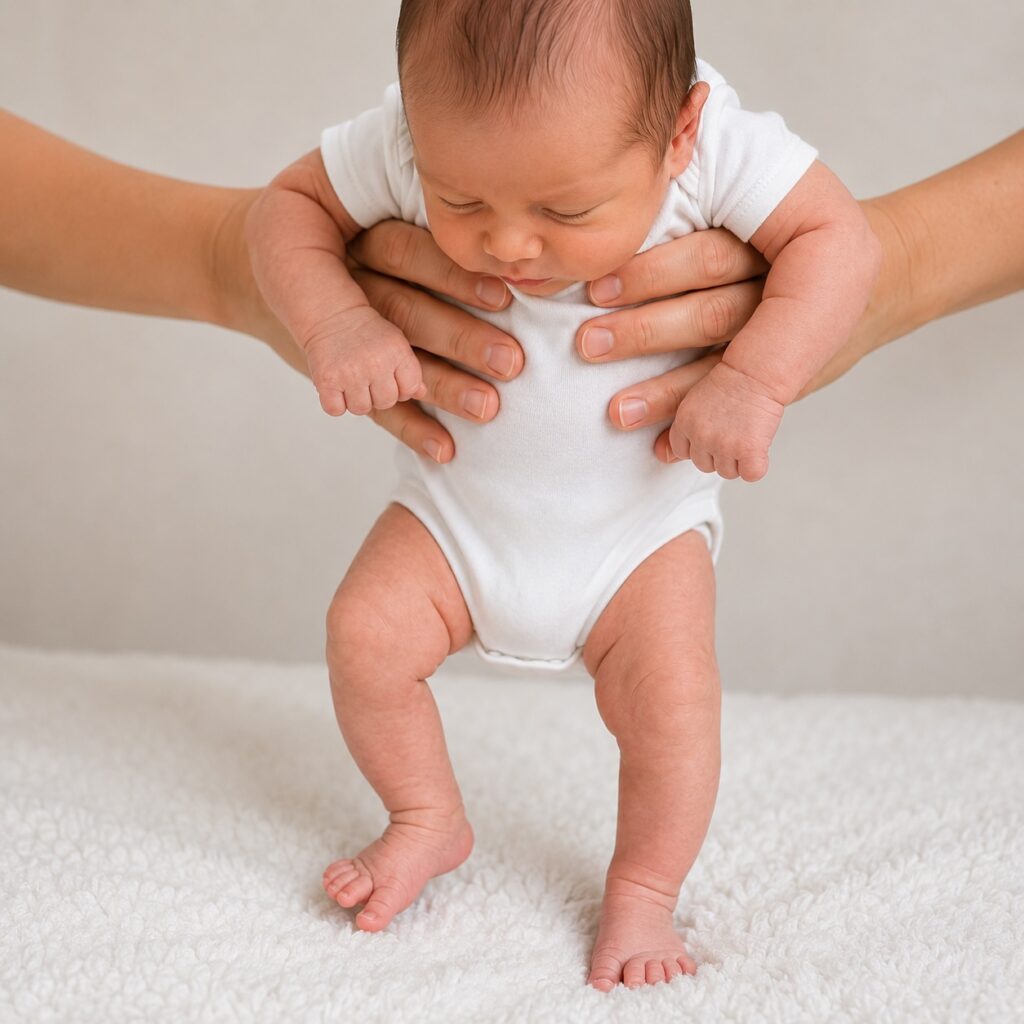
The stepping reflex in babies, also known as the walking or dance reflex, is a natural movement observed in newborns and young infants. When the soles of an infant’s feet touch a solid surface, they tend to lift one foot slightly before placing it down in a stepping motion. This reflex is typically present from birth to about two months of age. The presence of the stepping reflex is an important indicator of normal neurological development in infants. Parents may notice this reflex when gently supporting their baby’s feet on a flat surface, such as a bed or the floor.
Why does this happen?
The stepping reflex in babies is an involuntary movement that occurs when the soles of a baby’s feet touch a flat surface. This reflex is observed in newborns and typically disappears around the age of 2 months. The stepping reflex involves several body systems working together, primarily the nervous system and musculoskeletal system.
In the brain, specific pathways are activated when the soles of a baby’s feet come into contact with a surface. These pathways send signals down the spinal cord and to the muscles in the legs. When stimulated, the baby’s legs begin to move in a stepping motion, as if the baby is walking or taking steps.
The musculoskeletal system, including the bones, muscles, and joints, also plays a crucial role. When the foot touches a surface, it triggers a series of muscle contractions and relaxations that cause the leg to extend and then flex, mimicking a walking motion. This reflex demonstrates how the body’s systems are coordinated to respond to external stimuli, even at a very early stage of development.
The stepping reflex is part of the baby’s natural development and helps lay the groundwork for future motor skills. It is not necessary for the baby to practice this reflex for it to develop normally. As the baby grows, more complex motor skills will develop, gradually replacing these initial reflexes with voluntary movements.
Development over time
The stepping reflex in newborns typically diminishes and eventually disappears as the infant grows and develops. This reflex is observed in babies from birth to about 2 months of age. As the baby matures, the nervous system becomes more sophisticated, and the stepping reflex is replaced by more complex motor behaviors. Around 2 to 3 months, the infant begins to develop more controlled movements of the legs, such as kicking. By 6 months, when the baby is learning to sit, the stepping reflex has typically faded away, replaced by other motor skills that support the baby’s growing independence and mobility.
Normal variation
The stepping reflex in babies can vary among infants during normal development. Some babies may exhibit a stronger stepping motion, step more frequently, or continue the reflex for longer periods compared to others. These differences are typically nothing to worry about and reflect the natural variation in how each baby develops. It’s important to observe your baby’s overall growth and development, as consistency in other areas is a good indicator of normal progress.
Why understanding this matters
Understanding the stepping reflex in babies is important because it reflects early neurological development and maturation. The presence and progression of this reflex indicate that the baby’s central nervous system is developing as expected. As infants grow, these reflexes naturally integrate into more controlled movements, showing that the brain is learning to coordinate and control motor functions. This transition helps doctors and parents gauge the baby’s overall developmental milestones and neurological health.
Is this serious?
The stepping reflex, often observed in newborns, is a natural response where an infant’s legs move in a stepping motion when their feet touch a solid surface. This reflex is typically present in newborns and gradually disappears around 2 months of age as more controlled walking movements begin to develop. Generally, the stepping reflex is not considered a serious condition and is part of the normal developmental sequence.
However, it is important for parents to be aware of a few key situations where medical evaluation might be necessary:
1. If the stepping reflex is absent in newborns or continues past 2 months without other signs of normal development, such as the ability to lift the head and neck, it could indicate a need for further assessment.
2. If there is asymmetry in the stepping reflex, meaning one side of the body does not move in the same way as the other side, this may require further investigation to rule out underlying neurological issues.
In most cases, the stepping reflex is simply a normal phase of early development and will resolve as other motor skills emerge. Monitoring your child’s overall developmental milestones and discussing any concerns with your pediatrician can help ensure your baby’s healthy growth and development.
What is usually recommended?
For parents and caregivers, observing the stepping reflex in a baby can be both fascinating and reassuring. It is generally recommended to gently handle the baby’s legs during diaper changes or while laying them down for sleep, allowing their natural stepping movements to occur. This can be done by lightly touching the soles of the baby’s feet, which may trigger the stepping reflex. It is important to note that these movements should not be forced or prolonged, as they are natural responses that occur spontaneously.
As the baby grows, these reflexes naturally diminish and are replaced by more controlled motor skills. Parents can encourage gentle, safe movement by providing a supportive environment for the baby to explore. Simple activities such as placing the baby on a soft, flat surface and allowing them to kick their legs freely can help promote healthy development of motor skills.
In daily care, it’s crucial to be aware of the baby’s comfort and signals. If the baby seems uncomfortable or stops moving their legs, it’s best to pause and ensure they are relaxed and in a comfortable position. Gentle handling and providing a safe space for the baby to move freely are key aspects of nurturing their natural reflexes and development.
When should parents worry?
Parents should seek medical advice if the stepping reflex does not appear by the age of 2 months or if it persists beyond 5 months. Additionally, if a baby shows a significant asymmetry in the stepping reflex or has other developmental delays, consulting a healthcare provider is advisable. These observations can help ensure the baby’s neurological development is on track.
Doctor’s note
The stepping reflex in newborns, where they appear to walk when held upright with their feet touching a surface, typically diminishes by 2 months of age. This reflex is a normal part of infant development and does not require any specific action from parents.
Frequently Asked Questions
How long does the stepping reflex last in babies?
It typically disappears by 2 months of age.
Can I encourage the stepping reflex at home?
No, it’s a natural reflex that doesn’t need encouragement.
Is the stepping reflex a sign of healthy development?
Yes, its presence is a normal part of early infant development.
Should I worry if my baby doesn’t show the stepping reflex?
If your baby is younger than 2 months, it’s not a concern.
Does the stepping reflex mean my baby can walk soon?
No, it’s a reflex that doesn’t predict walking ability.
Can the stepping reflex be mistaken for other behaviors?
It can be confused with crawling or early walking attempts.
Is the stepping reflex the same as the walking reflex?
Yes, they refer to the same reflex observed when the baby’s feet touch a surface.
Does the stepping reflex indicate future athletic ability?
No, it doesn’t predict future physical abilities or talents.
Can the stepping reflex be affected by premature birth?
Premature babies might show the reflex later or less strongly.